October 03, 2021

Tissue Paper Ghosts with Googly Eyes

Each ghost is made from tissue paper and googly eyes using materials from the Halloween kit. They are then hung from a piece of cotton cord.


1. Cut a 22x22 cm piece of tissue paper for each ghost.


2. Loosely scrunch up a head from cut-offs measuring approx. 2.5 cm, making sure the head is not too heavy to prevent it from tipping over when hanging.


3. Stuff the head inside a large piece of tissue paper, wrap around and tie it tightly with a long piece of cotton cord.


4. Attach eyes with Clear Multi Glue Gel. Make as many ghosts as you like and tie them equal distances apart onto the cord.

A Halloween coffin with spiders

 Decorate a wooden coffin with craft paint and Plus Color markers and use it for decoration for Halloween.


1. Paint the outside and the inside of the coffin with two coats of dark craft paint. Leave to dry between each coat. Cover any metal parts with masking tape.


2. Draw spiders' webs with a Plus Color marker.


3. Attach the spiders with Clear Multi Glue gel.

March 21, 2019

A Chest of Drawers decorated with self-adhesive Film

This small chest of drawers is painted with craft paint. The drawers are then decorated with self-adhesive film.


1. Paint the surfaces and the edges of the chest of drawers with craft paint.


2. Place the front of the drawers on top of the self-adhesive film. Draw around the outline of the front of the drawer and cut out.


3. Attach the self-adhesive film onto the front of the drawers.


March 14, 2019

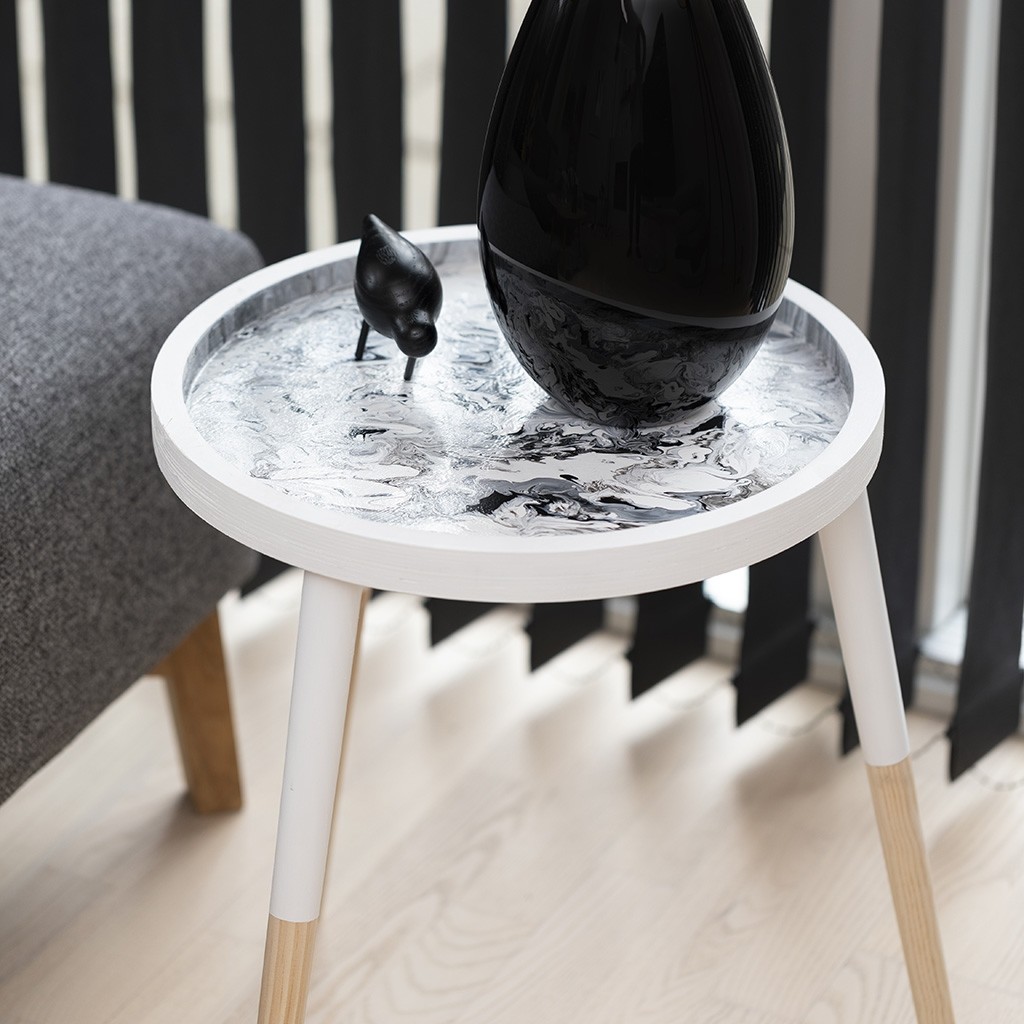
Fluid Art on a wooden Tray Table made with Pouring-Fluid

Fluid painting on a small tray table. The tray table is decorated with Pouring-Fluid mixed with craft paint and painted with craft paint.


1. Cover the edge with a narrow strip of masking tape. Pull the masking tape tight and push it onto the edge, ensuring that the paint won't seep underneath the masking tape. Cover around and underneath the base using a wider strip of masking tape.


2. Apply a generous coat of Pouring-Fluid onto the surface of the table and edge using a spatula or a brush to make the paint run smoothly.


3. Mix the Pouring-Fluid with craft paint in a ratio of 1:1. The paint must be very runny. The colour strength won't be diluted when it's mixed with Pouring-Fluid. Pour the first colour around the edge.


4. Immediately pour the second colour in a thinner line.


6. Lift the tray upright and turn it to mix the paint on the inside edge.


7. Pour the first colouronto the inside base of the tray.


8. Pour the second colour on top using a much smaller amount.


9. Lift the tray and turn it so that the colours run into eachother, making a marble pattern. Turn in all directions. The paint must cover the entire surface.


10. Turn the tray upside down to pour off excess paint.


11. Carefully remove the masking tape.


12. Cover the table legs with masking tape 20 cm from the top. Paint using undiluted white craft paint. Preferably apply two coats.


13. Paint the bottom of the table and screw on the legs. Carefully paint the edges. A TIP: the wooden grain rises when it's being painted. Sand between coats for a smooth finish.

March 05, 2019

A Hand cast in Plaster in a disposable Glove


This hand is cast in white plaster compound in a disposable latex glove.


1. Pour water into a bucket and sprinkle plaster compound slowly until it forms a peak at the surface of the water. Leave it for about 8 min.


2. Stir well until air bubbles form on the surface. NB: Plaster generates heat during hardening (the larger the quantity, the greater the heat).


3. Pour the mixture into the disposable glove. A TIP: Ask somebody to help you hold the glove whilst pouring to ease the process.


4. Close the glove with a piece of string, tied tightly.


5. Leave the filled glove to dry on top of a round object in order to get a hollow shape. Leave to dry for approx. 1 hour. Cut away the glove.


Another example with other variants


Another example with other variants

February 27, 2019

Landscape photographs by Wang Wusheng


Wang Wusheng’s 汪芜生 landscape photographs offer a timeless journey through sacred mountains, such as the Mount Huang also known as the Yellow Mountains. Located in Anhui province in northern China, this mountain range famous for its steep peaks has been standing at the centre of Wang’s works for over four decades. When he climbed for the first time the mountain in 1974, he felt a strong feeling that he described as the following: “Far from earth, yet at the heart of the universe. My mind had never been so wide open before. For five to six hours I stayed on the mountain, forgetting all my troubles. In the silence, there was a kind of sound. That is the source of my inspiration.”

Wang’s photographs plunge the viewers into scenic views of crab like pine trees and sea of clouds swirling around mountain peaks. “I’ve never been to Huangshan,” explained the photographer and curator Rong Rong, “but the first time I saw Wang Wusheng’s work, I was drawn in by his imagery – his skill of portraying Huangshan in photographs. It is not easy to use photography to express a place made famous by its association with traditional landscape painting.” Mount Huang has indeed been a recurrent subject matter in Chinese pictorial tradition for centuries, and Wang’s photographs connect with this long lineage.

More information: www.wangwusheng.com

Wang Wusheng

Wang Wusheng
Wang Wusheng
Wang Wusheng
Wang Wusheng
Wang Wusheng

March 04, 2016

Transylvania by Mathieu Le Lay

Mathieu’s passion for cinema & nature guided him to perform a year of study at IFFCAM, the French wildlife film school, after he graduated in wildlife conservation at Salford university (UK).

Since 2008, he is directing films to tell stories about his fascination for strong interactions between man and the wild environment.

The documentary film genre allows him to stage his characters playing at their own role, adopting a more intimate approach when filming on the field. He also looks for personal aesthetics & evocative atmosphere in his visual style & cinematography.

More info: www.mathieulelay.com


July 15, 2015

Golden Sea of Canola Flowers in Luoping, China

In early spring t you can witness an amazing “Golden Sea” of canola flowers. The canola flower fields in China are one of the world’s beautiful sight’s in small Luoping (Yunnan, China). Vast farmlands get covered in golden, yellow rapeseed flowers stretching as far as the eyes can see, all the way to the horizon. The best time to visit Luoping for this visual fiesta is February through March, by June the show is over.